Love, Translated
  • Love, Translated?
  • Yet more about me
  • Contact me
  • Get email updates

The World Is Not Enough

03/15/09

I have nothing but respect and appreciation for people, businesses, and institutions that take the effort to translate their signs into Spanish. Whether they do it out of respect, appreciation, or just business savvy, I can’t help but feel somewhat flattered.

But every once in a while, you run into translations that are such a disaster, they bring to mind the scene from the movie “The Mexican” where Brad Pitt asks a crew of Mexican laborers: “take me in your el truck-o to the next el town-o”.

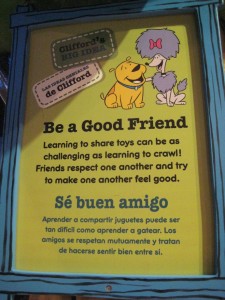
We ran into one such botched translation today at the Children’s Museum. In the newly unveiled Clifford the Dog room, I ran into exhibit A shown in the picture below on the left. My humble translation of the Spanish translation would go something like this: “Manufacture your own music! A step in phase with Clifford and the friends. Push a button on the wall to achieve beginning.”
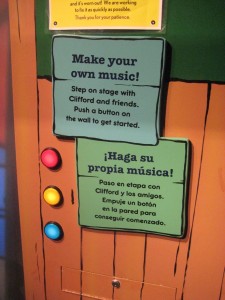
Manufacture your own music

Manufacture your own music

Friends are respectful of one another

Friends are respectful of one another

In this case it is clear that someone ran the original English text through a translation algorithm (ala Babel Fish) and the output was not validated by a person who’s fluent in Spanish. Unfortunate. What’s interesting, though, is that there were other signs also translated into Spanish, but quite flawlessly (like in the image on the right).

I suppose the only way that something like this could affect my child is if when he starts going to school he receives instruction based on materials that are equally as shoddy as the first sign (which is unlikely), but it does serve as reminder that he’ll need some solid language basis at home if I want to keep him from going around town “stepping into phase” in order to “manufacture music.” On the other hand, I could learn something from the second sign and like a good friend, be respectful and make my friends feel good.


Share Button
Categories: Reflections, Trivial Occurrences


0 Comments

How Do You Say “Blueberry”?

03/14/09

Imagine: It’s a bright Saturday morning, the birds chirp outside as if auguring the beginning of Spring, and our happy little bilingual family is placidly gathered at the large, dark wooden dinning room table to eat breakfast.

Photo by .craig

Photo by .craig

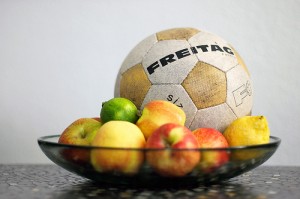
I enthusiastically begin to mix blueberries into my son’s yogurt and as the purple swirls form patters against the white background,  I describe in Spanish each of my actions to my little boy but I stumble when I get to the part where I say: “…look at the purple juice coming out of the………[how the heck do you say blueberry in Spanish??…]…hmmm….FRUITs!”

How sad is that?

My wife laughs and my son is left with an irreparable gap in what could have otherwise been an instructive experience.

What’s the point of all this? The point is that making the decision to raise a bilingual child has done something interesting to my Spanish:

1. It has forced me to recall many words and expressions that I haven’t used in years and some that I had almost forgotten

2. It has made me realize the gaps I have in my own native tongue

Number 1 can be explained by the fact that I’ve been here for twelve years and I speak English for the majority of my day. Number 2 is a bit more complicated.

What kind of dimwit wouldn’t  know how to say “blueberry” in Spanish? I don’t know. The more romantic and literarily embellished justification is that I grew up poor and blueberries are probably rare and expensive in Colombia so we never had them at home. Just like we never ate strawberries and other wildly exotic fruits. In general, it’s just a challenging problem of exposure and cultural relevance.

What? Let me explain:

– I already mentioned I never ate blueberries in the old country. So I went and looked up the word in the dictionary and the Spanish word for blueberry is “arándano”, which is a word I remember hearing before but have never, ever used in a sentence. If I were to guess what an “arándano” is, I would have said it’s probably a filthy, lazy person. But no, it’s a blueberry, so now I know.

– Car seats, booster seats: how the heck do you say these things in Spanish?  I arrived in this country at the tender age of twenty. Before that, I rarely rode in a private car (I mostly hung from the doors of a crowded bus to get from point A to point B), so my family never sat around the dining room table pondering the benefits of space-age straps on our car seats or booster seats. I imagine when I was a baby I either sat on someone’s lap to eat or at best, my mother rolled up a pillow or a blanket to prop up my behind such that my young fingers could reach for food placed on the table. So for now and until I talk to someone in Colombia who uses these things, my son and I refer to his booster seat as a “silla”….a “chair”. Kind of a disservice to the boy, but I’ll try to do better.

And the list goes on and on: “bouncy chair”, “sippy cup”, “etch-a-sketch”, “Credit Default Swaps”, “Overleveraged Banks”, “Toxic Asset Relief Program”– my head could explode.

So clearly, my boy and my wife are not the only ones learning Spanish in the house. For the foreseeable future, every time I think of a blueberry, I’ll first think of a filthy, lazy person, and then about the fruit. And I’ll look into getting a Spanish dictionary application for the iPhone.

Share Button
Categories: Trivial Occurrences


3 Comments

The Small Divide

03/06/09

During the three years my wife and I have been together, she has learned a lot of Spanish, but she doesn’t speak it fluently. We both understand and take seriously the need for her to be comfortable with Spanish if we want to be effective as we can be at raising our children bilingual.

Photo by tanakawho

Photo by tanakawho

But life is busy, and having an 18-month old boy and another one on the way leaves hardly any time to keep up with laundry, let alone commit to the major undertaking that is learning a new language as an adult.

So we worry a little bit. We certainly haven’t abandoned our plans to help her learn the language as fully as she can, but day after day, we seem to be falling back on plan B, which is: learn as you go.

We’re already running into situations where we we accidentaly undermine each other because she didn’t fully understand something I told our boy to do or not to do. Nothing serious, but I can already see us getting to the point where I will have to either speak to my boy very slowly so that my wife can understand what’s happening, or get into the habit of translating for her what might be important for her to know at the moment.

Now, assuming that we stick with the status quo and rely solely on my wife’s sharp intellect (which is sharp indeed, no joke — love you baby!–) and just let her learn as we go, I wonder what impact that will have in the long run as I try to establish an environment where my children will speak only Spanish to me (dellisional much?) and English to their mother, without effectively excluding her from the interactions in Spanish.

I would love to hear from people who have been in this situation. I have no doub that we will make it work, but I do wonder how difficult it will be. I know my wife will learn Spanish sooner or later (she already has been), but I want to be prepared for the bumps along the way.

Share Button
Categories: Questions, Reflections


0 Comments

Ain’t Ain’t A Word

02/18/09

I guess you could say I’m proud of my blue collar/working class background. Of course, when I was a youth I often felt wretchedly disadvantaged, especially at that age when it becomes important to wear certain brand jeans and sneakers to be considered a worthwhile human being or a worthy suitor to the neighborhood’s prettiest girls.

Photo by schaaflicht

Photo by schaaflicht

But now that I’m a relatively mature adult, I am deeply grateful not only for the efforts made by my parents to support us but also for the lessons that my working class environment thought me.

Of course, this website is only partially about self-congratulating for how remarkable I am. My point here is that because of my background, I grew up speaking a certain brand of Spanish specific to my region and to my social environment. And I love it. I love it so much and it’s so much a part of me that I speak in that way to my son some times. To put it in perspective, imagine using an English sentence with your child along the lines of: “Ain’t no dang dog gonna bite you”.

So by now, you see my dilemma — Do I try to steer away from this form of Spanish so that my child learns instead a “proper”, “standard” (and perhaps more sterile) form and is therefore better able to communicate in Spanish with people from all regions of all Spanish-speaking countries? Or do I stay true to who I am and trust that what I’m teaching him is not so drastically slangy that it won’t be a detriment to his ability to communicate?

I have to admit this question comes as much from actual curiosity about the best thing for my child as it does from my own desire to reaffirm my “Colombianness” after years of not living in my native land. But I’m again letting my personal insecurities permeate this blog so I’ll save those for my upcoming “Poor Me” blog. Though it is worth admitting that part of why I proposed this topic of slang and regional variations of the tongue is because I want my children to fully embrace all aspects of their background (Colombian and American) and I feel like a part of that is learning to speak and understand the colloquial version of the language that they will inevitably hear from my family back home and from many of my friends here. So maybe as I write this I’m answering my own question–It seems like love, communication, and open discussion about what it means to be Colombian and what it means to be American (and what it means to be Colombian-American) is the best education I can give them and the rest can be figured out along the way and is not that big a deal.

Share Button
Categories: Questions, Reflections


2 Comments

Ball, Pelota

02/17/09

So I spoke too soon and I need to come to terms with the fact that I’m now somebody’s “old man”, so I can expect going forward to be amazed at the brain abilities that this generation I’m ushering in is developing at the same rate that I’m losing them.

Photo by Dom Dada

Photo by Dom Dada

Almost as soon as I got done talking about how I need to let my boy pick whatever darn language he chooses to express any given word, he one day comes home pointing at his play area and showing me his “pelota” (ball). “Ball” was his very first word, so it stands to reason (*my* reason) that it would be the most deeply ingrained in his gray matter and neurological circuits, but for whatever reason, he is now able to refer to a ball as pelota for papá and as ball for those unfortunate souls who don’t happen to be papá.

Photo by Dom Dada spacer
Share Button
Categories: Trivial Occurrences


0 Comments

Eh-Plame!

02/05/09

My 18-month old son goes to a Spanish-speaking daycare four days a week. The exposure to the language he gets there, combined with the fact that I speak to him exclusively in Spanish, makes Spanish his primary language at the moment (to the extent that an 18-month old can have a primary language).

Photo by The Shane H

Photo by The Shane H

So out of the only-Jesus-knows-how-many words he can say and understand, I would estimate 90% of them are Spanish words (most words he understands in both Spanish and English).

But it’s really curious to me why, Spanish being his predominant language, there are words he will only say in English. “Airplane” is one of those words. When he hears an airplane flying overhead, he opens his beautiful brown eyes very wide, purses his lips, and excitedly exclaims: “Eh-plame!”

So at first, I was excited that he was saying a word I hadn’t heard before. I assumed his mother had tought him its meaning and how to say it and I was happy to find the word as evidence that he was in fact acquiring language from the both of us. But then, I tried to teach him the equivalent of the word in Spanish. “Avión, avión, avión, AVIÓN!!!” I would try to drill into the poor guy’s head, expecting that he’ll use the Spanish word with me and the English word with his mother, to no avail. “Eh-plame” was the word and has been for the last few weeks and there is not a darn thing I can do about it. And that’s fine. But natually, this phenomenon puzzles me and as I let my boy develop his language skills in a natural, organic way, I wonder how those decisions are made by his young brain. Just like “airplane”, there are a few other words he will only say in English: “ball” (his first official word), “bus”, “more”, etc. All I can do is nod my head in understanding, repeat the equivalent word in Spanish, and smile proudly at my strangely billingual little boy.

Share Button
Categories: Trivial Occurrences


0 Comments

   Newer entries »

Search Site

Archives

  • August 2013 (2)
  • March 2013 (1)
  • January 2013 (1)
  • December 2012 (1)
  • March 2012 (4)
  • August 2011 (1)
  • June 2011 (2)
  • April 2011 (2)
  • February 2011 (3)
  • January 2011 (1)
  • October 2010 (2)
  • September 2010 (2)
  • August 2010 (1)
  • June 2010 (3)
  • May 2010 (1)
  • April 2010 (5)
  • February 2010 (1)
  • January 2010 (1)
  • December 2009 (1)
  • November 2009 (4)
  • October 2009 (1)
  • August 2009 (2)
  • June 2009 (3)
  • April 2009 (2)
  • March 2009 (6)
  • February 2009 (3)

Get Into It

  • Love, Translated?
  • Yet more about me
  • Contact me
  • Get email updates

Return to top

© 2015- Love, Translated