Love, Translated
  • Love, Translated?
  • Yet more about me
  • Contact me
  • Get email updates

And Then There Were Two

08/31/09

My young family was blessed in August with the arrival of our second son, Samuel. Since his arrival, there’s been nothing but happiness, joy, fun, and sleep-deprivation in our family, and both my wife and I walk around blissfully smirking in a state of deep contentment and sad dishevelment.

Photo by jk+too

Photo by jk+too

One of the many things that didn’t occur to me before Samuel arrived was a potential benefit of being a second child, beyond inheriting nicely broken-in shoes–Samuel will have a degree of exposure to Spanish language conversations at home that our first son Gabriel didn’t have.

So as I find myself holding Samuel in my arms while I converse with Gabriel in Spanish, I can’t help but hope that all those words that are being exchanged as he gleefully stares and coos, are imprinting in his brain a very strong basis for fluency in Spanish.

But why lean back and enjoy the prospects of an ever richer Spanish-speaking environment at home when I can start wondering and worrying about what’s going to happen 5 or 10 years from now? And the question that’s been plaguing me is: Is it too naive to think that there will be such a solid foundation in the Spanish language at home and such a firmly established habit in the boys of speaking Spanish with me (and dare I dream, to each other) that the surrounding, English-speaking environment won’t eventually turn them off to Spanish and cause them to rebel against their old man’s crazy mother tongue?

Of course, the sensible thing to do is to let them develop their language system organically and do what I can to ensure Spanish is always a part of their lives, even if that means they speak English to each other (or Spanglish as I’ve seen happen to other children in their situation) and the only time they speak Spanish is when they speak with me. But part of me thinks that, if I remain focused and turn on the charm big time (or bribe them), I could shape the dynamics of their relationship so that the natural thing for them will be to speak Spanish to each other. We’ll see. I better rest up for that battle.


Share Button
Categories: Reflections


2 Comments

In Case of Emergency, Scream in Spanish

08/01/09

This may be just wishful thinking, but I see the following anecdote as a sign of how deeply rooted Spanish is in Gabriel’s brain:

Photo by Ben Cumming

Photo by Ben Cumming

One recent night, after putting him to bed, I lumbered downstairs and started conjuring up idyllic images of my wife and me, placidly planting our derrieres on the couch to watch “I Love Money 2” or some such delightfully mindless trash. Fifteen or so minutes into our guilty pleasure, we began hearing faint whimpers coming from the baby monitor receiver in the living room. Very quickly, the whimpers turned into loud cries that alternated with words that were unintelligible to me.

Now, this is not an uncommon occurrence; my boy Gabriel some times goes on rants that last up to a minute only to peacefully go back, unaided, to dreaming about diggers and dump trucks. But this time, the pattern was clear and forceful and my wife, being the amazingly in-tune mother that she is, knew for sure that the boy wasn’t bluffing.

“Go upstairs,” she urged in a concerned tone. “I think something’s wrong.”

I reached for the remote in order to pause the TiVo (priorities!) and in a natural, unrehearsed dumb-ass tone asked: “What is he saying?”

“Mi pie?” said my wife, unsure about the meaning of the clamor.

“MY FOOT!” I said, springing for the stairs with agility uncharacteristic of someone who spends the better part of his life sitting in poor posture. The words in my boy’s desperate cry were Spanish for “my foot, my foot, my foot!”

When I got to Gabriel’s bedroom and turned on the light, I found his poor chubby foot stuck in the crib’s railing and his handsome sleepy face flushed and covered with tears.

The boy likes to rest one of his legs up on the railing while he sleeps and depending on the angle of the rest of his body, the foot might go into one of the spaces between the rails and lodge itself in there. And that’s exactly what happened.

I gently wiggled his foot out of the gap and tenderly rubbed it to allay his panic and my own guilt.

“Se te atrancó el pie en la cuna, nené?” [Did your foot get stuck in the crib, baby?], I asked, and the boy replied with a heartbreakingly sweet “Sí!¨ (or was his sweetness sarcastic and what he wanted to say was: “uh….no, I was  just practicing to become a contortionist toddler, old man!”…. nah, not yet…anyway…)

So in my post-crisis philosophizing, I was quite surprised and somewhat pleased that in a moment of high adrenaline, my boy’s brain fired up Spanish words to ask for help, and that gives me hope that as the predominantly English-speaking environment in which we live begins to displace and diminish his use of Spanish, at least there are some primal neurons permanently imprinted with good-ol’ Español that will always be there. On the flip side, I hope the memory of those torturous seconds of fruitlessly asking for help in Spanish gets erased by Thanksgiving.

Share Button
Categories: Trivial Occurrences


0 Comments

Little Heroes

06/16/09

A few years ago, I was acquainted with a couple from Mexico who were raising their two boys (ages roughly 4 and 6) in the United States. The couple didn’t speak much English and they naturally only spoke Spanish in the home. Furthermore, the children didn’t have (as far as I knew) any English-speaking buddies and were rarely around adults who spoke English. But they had something much more precious to the young, (and dare I say, male) mind: Television!

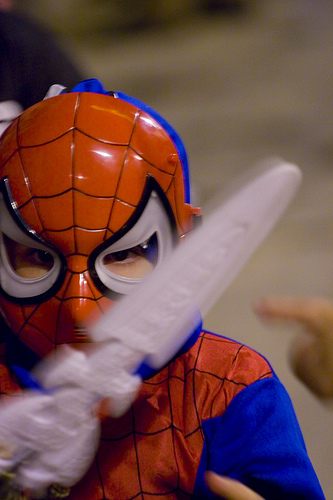
Little Spiderman

Little Spiderman

These two boys were hardcore fans of Spiderman (the cartoon version) and watched it on television any chance they got. Their parents didn’t impose any restrictions on their TV-watching, so over time, the young boys with their little spongy brains absorbed so many lines of English dialog from the Spiderman cartoons, that they began to develop their own pseudo-English language, made up of what sounded like permutations of lines from the show. You could see the two boys running around, chasing each other, and reciting in perfect English things like: “You will never get away with this, Electro!” or “This is the end of the road for you, Peter Parker!”

Now, I’m not in any way advocating television as a tool for language acquisition. In fact, as parents, my wife and I have committed to keeping our boys away from the tube almost entirely until they’re two years old, and to establishing a habit of watching very little television in general. However, as a speaker of English as a second language, I was utterly fascinated by these two super hero boys and how their language system worked for them, even outside the realm of play. It seemed like they were actually learning English from television alone! And that resonated with me because when I was younger, before I enrolled in formal English courses, I learned most of my English from watching Beavis and Butt-Head and The Real World on MTV, and from learning the lyrics to songs by Guns N’ Roses, Metallica, Led Zeppelin, Black Sabbath, and Aerosmith. Of course, this was not the same as true early language acquisition from the television, but I felt like I could relate to the boys’ excitement about the content and the almost accidental language implications. In my case, Beavis and Butt-Head were so bizarre and different that I had to try to understand what they were saying; The Real World was filled with so many beautiful and promiscuous people that I needed to learn to be like them; hard rock and heavy metal were so bad-ass, that I wanted to be able to sing along to the songs and understand the master plan of our Lord Satan. The language became a means to imagining myself the way I wanted to be: my own version of a super hero.

It seems like every day a new study comes out arguing about the degree to which television viewing can impact child development (in both positive and negative ways). Here are some headlines on the subject from the BBC News website:

“TV ‘linked to short-sightedness’”

“TV watching link to child obesity”

“Children’s progress ‘hit by TV’”

“Watching TV may speed up puberty”

As a child who grew up watching about 4 hours of television a day, I’m unsure as to whether I was just lucky or if I had enough other positive simuli in my life to keep television from turning me into a stupid, prematurely-pubescent, short-sighted fatso. Now that I’m a parent, however, I will try my darndest to set aside a few hours every night to make myself into my boys’ superhero, even if I’m totally boring and look ridiculous in spandex.

Share Button
Categories: Trivial Occurrences


0 Comments

Latin American Strongman

06/06/09

As a still fairly new parent, I’m gradually finding more comfort in the fact that most of my boy’s new little quirks have already been documented, explained, and dealt with by generation after generation of parents before me. (Others will possibly be labeled with 3-letter acronyms an deferred to prescription medications, but that’s a social criticism I’ll undertake if and when the time comes).

Photo by Deanna Lynne

(not my actual son) Photo by Deanna Lynne

Example of one of those normal quirks: “Toddler Refusal”

My boy’s thing for the last few weeks has been to test the limits of his free will by answering “no” (and in a pretty mean tone, too!) to every question or request, even if it’s something he actually would want to do, such as:

Parent: “Hey, kiddo, do you want to gorge on this 20 lb pile of sugar and marshmallows?”

Kid: “NO!!” (as he slowly makes his way towards said pile)

Naturally, we’re not exactly thrilled with our sweet boy’s subversive attitude and while we understand this is a completely natural and likely brief developmental phase, we’ve tried to channel it into a more positive expression of free will. My wife started by teaching him to say “no, thank you” instead of “NO!”.

[the frequent reader may find a pattern here — my wife does all the hard work and I come home after work to reap the benefits…but that’s outside of the scope of this blog].

The “no, thank you” technique has proven quite effective. The boy will still say “NO!” somewhat frequently, but when asked what he should say instead, he’ll quickly correct himself and there have been a couple of times when his first response has been a very polite “no, thank you”. The glory! But you know what’s REALLY cool? After my wife accomplished the feat of turning this testy attitude into proper communication (in English), the first time he said “NO!” to me directly, I asked him “cómo se dice?” (“what do we say?”) and he responded “no, gracias, papá” (“no, thank you, papá”), without requiring prior training from me.

Besides it being really cool, this seems like an indication that mine and my wife’s parenting efforts and verbal instructions are surprisingly language-independent. Provided that we stay consistent and on the same page, what one parent teaches can be reinforced by the other very readily without the need to build up the lesson in the other language from scratch.

Does this mean that I will let my wife do the heavy lifting on the parental discipline area? “NO!”

Do I like it when people ask themselves rethorical questions and then answer them? “no, thank you”

Share Button
Categories: Trivial Occurrences


0 Comments

Big Boy

06/05/09

Like any other decent celebrity, I primarily thank my fans for giving me the energy and the encouragement to keep going. So it is to all of those fans around the world (i.e. my wife and my best friend in Colorado), that I want to offer my apologies for resting on my laurels and not keeping up with the blog. As you know, I’ve been busy raising a child and preparing for another one.

Photo by freakapotimus

Photo by freakapotimus

But enough about my hiatus from the limelight. Let’s catch up, shall we?

My boy keeps growing strong, smart, and handsome and continues to teach me things about myself as a man, as a father, and as a language teacher. He is now 22 months old and his vocabulary in both Spanish and English is almost conversational (at least for those of us who understand the words he mutters).

So now that the boy can utter some complete sentences and carry a back-and-forth exchange of some basic ideas, we explained to him (purely for the sake of our own amusement) the notion that he is no longer a baby but rather a “big boy”. It started with my wife telling him: “You are no longer a baby, are you? you are a big boy”. That created the perfect trifecta:

1. “Big boy” (in English) has the kind of sonority that makes a child like my boy want to say it not just once by many times. So if my wife asks him if he’s a baby, he’ll say “big-boy-big-boy-big-boy-BIG-BOY”

2. My wife was the one to introduce the game, so it seems like his little brain assigns the priority response to the English version. (i.e. if I ask him if he’s a baby in Spanish, his first impulse is to say “big boy” in English)

3. Spanish for all its sexiness and musical cadence is a heck of a lot more verbose than English, so even though my boy knows that “niño grande” is what he should be replying to his papá, it just seems like a big hassle and after all, why the heck did you move to America then, old man?

If you’re a returning reader, you may find a parallel between this post and my post about “eh-plames“.  It is interesting to me to realize that the predicament of how to enforce acquisition and usage of both English and Spanish in a balanced way is going to require a sustained effort and may even require sending the boy to the old country for a couple of summers later on, when he is a “bigger boy”.

Share Button
Categories: Questions, Trivial Occurrences


0 Comments

Transnational Raunchiness

04/14/09

Some times one can find huge coincidences and similarities between otherwise very different cultures and languages.

Photo by deiz92

(not my actual son) Photo by deiz92

Take for example, the oh-so delightful phenomenon where kids who are learning to speak, pronounce words in ways that make them sounds like profanity. You know, your beautiful child’s mouth innocently (and unwittingly) emitting R-rated epithets, much to the delight of your juvenile friends and YouTube followers.

But what is really mind-blowing to me is that such tricky words or concepts be the same in two very different languages.

For a couple of days now, I’ve been working with my automotively-obsesed boy to get him to learn the Spanish word for “truck”, which is “camión”. Maybe you see where I’m going with this: Many toddlers seem to have trouble with the word “truck” and end up pronouncing in a way that makes it sound like the infamous f-word. [CASE IN POINT – click here].

Well, my child’s pronunciation of the word “truck” is Shakespeareanly flawless. But wouldn’t you know it? Its Spanish equivalent, “camión”, when pronounced by my boy, sounds like “cabrón” (with apologies to my Spanish-speaking readers), which means something a bit more egregious than “a-hole”.

How is that for an argument for equality of all races and nationalities?

Share Button
Categories: Reflections, Trivial Occurrences


2 Comments

Clarity

04/03/09

Trying to raise a bilingual child brings to the surface the many semantic subtleties of language.

Photo by slayer23

Photo by slayer23

Yesterday, my boy was excitedly going about his routine of taking as many toys as he could out of their assigned places in his play area, which he does especially diligently when he comes back from daycare because he still likes us and is happy to be home.

In the middle of creating this little “toynado” (to borrow a term from a co-worker of mine), he stumbled upon a hairbrush that either I or his mother had absentmindedly left there. With a serious look on his face, he held the hairbrush up for me to see, and because he knows I’m a trained monkey and will react to every stimuli coming from him, I earnestly informed him:

“Sí, nené, eso es un cepillo” (“Yes, baby, that’s a brush”)

The boy’s face lit up with understanding and he proceeded to jam the large hairbrush in his mouth. Talk about Gross Domestic Product!

In Spanish (at least in Colombia), we use one simple word (“cepillo”) to refer to any kind of brush — hairbrush, toothbrush, brush to scrub foul toilets, brush to comb the hair of mangy dogs or valuable stallions. Of course, for the sake of specificity, one could say “cepillo de dientes” (brush for teeth), but c’mon! Who has time for that?

So the only context in which my very unfortunate boy has heard the word “cepillo” is during our nightly wrestling match when I threaten to strap him down to the bathroom floor if he won’t let me brush his teeth. And therefore he thinks that any “cepillo”, no matter its intended purpose or its size, is to be used in his little, partially toothless mouth.

So now, I’ve learned a lesson that will prepare me for other subtlies of cross-language upbringing. I’ll have to explain to him why in Spanish the term for “toes” is “finger of the feet” and why, unlike in English, we have a very short and punchy word for “stinky feet”….”pecueca”. And come to think of it, why there seem to be so many nuances to the subject of feet.

Share Button
Categories: Trivial Occurrences


0 Comments

Already Mocking Me…

03/30/09

If you live in the USA and your native language is not English, you’ve probably experienced this: You take a phone call or have a conversation with another person in your native language, in front of a third person who doesn’t speak it. After you’re done, you look at that third person’s face and notice an awkward smirk of utter perplexity and they tell you: “All I heard was ‘glahhhrahh-glahhhrahh-glahhhrahh-glahhhrahh-glahhhrahh'”.

Photo by Tyla'75

Photo by Tyla'75

I’ve experienced this many times and I think it’s endearing. And if the person hearing the “glahhhrahh-glahhhrahh-glahhhrahh” is respectful, it makes me feel special to posses the key to a code that other people find mysterious and fascinating (or annoying). But I never expected to run into this situation in the sanctity of my home, and in somewhat of an inverse way.

My son has taken a three-pronged approach to immediate verbal fluency:

1. Spanglish: Like I’ve mentioned before, he’s pretty good at using Spanish words with me and English words with mom for the same things, but with increasing frequency, he’s starting to mix the languages.

2. “Dah-Dah”: I had also mentioned that he’s filling in some blanks with the word “dah-dah”….probably our fault for treating him like a baby. I’ll probably have to address this seriously when he’s 22 and still living in our basement.

3. Yodeling: Perhaps due to his German heritage on his mother’s side, a yodeling gene seems to have activated itself in my boy. So I’ll be changing him and blathering away like I always do, and my boy will start going on rants that go like this:

“Yudl – Ay – EEE, Yudl – Ay – EEE, Yudl – Ay – EEE, Yudl – Ay – EEE, Yudl – Ay – EEE…..papá” or

“Yudl – Ay – EEE, Yudl – Ay – EEE, Yudl – Ay – EEE, Yudl – Ay – EEE, Yudl – Ay – EEE…..perro” or

“Yudl – Ay – EEE, Yudl – Ay – EEE, Yudl – Ay – EEE, Yudl – Ay – EEE, Yudl – Ay – EEE…..silla¨…

You get the idea.

And it is this third approach that leaves me as perplexed as that third person unfamiliar with the language, feeling like all I heard was “glahhhrahh-glahhhrahh-glahhhrahh”.

It is fun to see the boy mock-stringing long sentences together by throwing in here and there some of the words that he knows and filling the rest with yodling. It shows resourcefulness, creativity, the fact that he has his daddy’s tendency to cut corners and do as little work as possible, and it is the cutest thing to watch. Oh, and it humbles me to witness a conversation where all I heard was “Yudl – Ay – EEE, Yudl – Ay – EEE, Yudl – Ay – EEE”

Share Button
Categories: Trivial Occurrences


0 Comments

Chaos Theory

03/24/09

With all the earnestness of a loving and proud father, I took my boy for a walk around the lake this weekend so we could take some fresh air, get some exercise, and spend some quality “boy time”. In a particularly tranquil moment when we were both taking in the bluish expanse of the frozen water, I kissed my boy’s forehead and told him: “Te amo” (“I love you”, in Spanish), to which he briskly responded:”I wouh you!” (“Te amo”, in gosh-darn English).

Photo by tomt6788

Photo by tomt6788

Three simple words from a very tiny person encapsulate the excitingly frustrating universe-in-development that is the process of multiple-language acquisition.

If my creationist friends out there will excuse me the metaphor, I imagine my boy’s little brain undergoing a micro Big-Bang where words and phrases in multiple languages spin, collide, fuse, and arrange themselves, all striving towards an ordered system. But in the process of arriving at such order, Papá will continue to be perplexed by his boy telling him that he “wouhs him” in the “wrong” language.

I have been exceedingly impressed by what I’ve perceived to be my boy’s precocious understanding of the difference between Spanish and English, particularly as it relates to choosing the people he speaks each language to. For example, for a good number of weeks now, he knows to use “please” with his mother and “por favor” with Papá, for the same purposes. But that precociousness seems to have given way in the last couple of days to unexpected bouts of regression/confusion and just plain linguistic surrealism. Or maybe the boy’s just getting cocky and creative. So we get exchanges like the following:

– Q: “Nené, cuántos zapatos tienes?” (how many shoes do you have?)

– A: “Twohs” (amalgamation of the words “Two” and “Dos”)

In addition, the boy has taken to filling the blanks for anything he doesn’t yet know how to say with the expression “dah-dah”. Oh, the humanity!

I hope it’s clear that I’m mostly joking and that  I’m not at all worried but rather increasingly fascinated and puzzled by this process. A sensible human being in my circumstances might take some time out of his day to pick up a book and see what the explanation for this phenomenon is, but alas, we’re talking about me here so instead what I do is blog about it and continue to let the chips fall where they may, but not without blowing on them a little bit to nudge them in the direction of my choice.

Share Button
Categories: Reflections


0 Comments

Little Fatty

03/19/09

I used to call my boy “Gordito”, which in Spanish means “Little Fatty”. It wasn’t an underhanded homage to his healthy roundness, chubby cheeks, double-chin, and thighs (which as far as I’m concerned are desirable in a baby). It was simply an endearing nickname I gave him out of love and based on tradition (it would be a very common thing to call a child in Colombia, even if they’re not chubby).

photo by Azrael

photo by Azrael

My Colombian friends wouldn’t even bat an eye when I used the appellative in front of them, but in front of an “Anglo” audience, I would almost invariable be asked what the name meant and they would react to the answer with awkward giggles. For a long time, I forced myself to remain firm and defend the name, because it’s cute, meaningful, and in the context of the language and the culture, the sounds of the consonants and the vowels in the word have a certain affectionate musicality to them. But I finally caved and gave it up.

Why?

For a couple of reasons:

-I grew tired of the giggles

– He’s already begun to slim down now that he can walk and run around

– I may be overreacting, but a person’s weight in American culture is a more taboo subject than it is in Colombia. Just the other day, my pregnant wife and I were video-chatting with my family in Colombia and my sister (who happens to be pretty “gordita” herself) told my wife that she looked “huuuuuge”, but she intended it as a compliment–my wife’s “hugeness” was seen as a testament of a healthy pregnancy. But I digress. In the case that my boy does turn out to be rather portly, the last thing I want is to draw attention to that fact with a nickname

But being the neurotic overthinker that I am, I have wondered how many more aspects of my “old” culture  I’ll have to adapt (or suppress) in order to comply with American social norms for the sake of my children. I probably sound like a pushover who’s unwilling to fight for traditions that might enrich the character of my children, but parents by nature do so many embarrassing things that I rather not add to that fate by making my children have to explain why their mean daddy is calling them fatsos. I’ll pick my battles and just fight the good ones…and we’ll see what trait I’ll be teasing my next child about.

Share Button
Categories: Reflections


2 Comments

« Older entries    Newer entries »

Search Site

Archives

  • August 2013 (2)
  • March 2013 (1)
  • January 2013 (1)
  • December 2012 (1)
  • March 2012 (4)
  • August 2011 (1)
  • June 2011 (2)
  • April 2011 (2)
  • February 2011 (3)
  • January 2011 (1)
  • October 2010 (2)
  • September 2010 (2)
  • August 2010 (1)
  • June 2010 (3)
  • May 2010 (1)
  • April 2010 (5)
  • February 2010 (1)
  • January 2010 (1)
  • December 2009 (1)
  • November 2009 (4)
  • October 2009 (1)
  • August 2009 (2)
  • June 2009 (3)
  • April 2009 (2)
  • March 2009 (6)
  • February 2009 (3)

Get Into It

  • Love, Translated?
  • Yet more about me
  • Contact me
  • Get email updates

Return to top

© 2015- Love, Translated